
A Letter Your Cleaners-3
A Shinchon Love Song, Part 1
If the memories we share can serve as a joyful support for one another’s lives today, that is a true blessing.
On the day my wife held our newborn granddaughter for the very first time, she cried out in utter surprise. “Oh my goodness! Look at this baby! Her palm lines are exactly the same as mine! How could this even be possible?” I simply smiled at her reaction, and to this day, I have never actually compared the baby’s palm lines with my wife’s. Hearing about this moment, my brother-in-law back in Seoul sent us a KakaoTalk message: “Well, it won’t be long before that little girl starts dancing and singing just like her grandmother…”
My very first memory of my wife goes back to when I was in my sophomore year of high school. At the time, she was just a first-year middle school student. Watching her dance so passionately to the “Soul Dance”—which was incredibly popular back then—I remember murmuring to myself, ‘I wonder what that little girl will grow up to be?’ Years later, when she graduated from college ahead of me and became a schoolteacher, I was doing nothing more than wandering around like a penniless bohemian. It was around that time that we courted and eventually married. Having spent our entire lives together—from childhood to youth in the same neighborhood and the very same church—we still find ourselves constantly reviving those old memories even now, as we work side by side in our dry cleaners here in America.
The year 2016 was a time when my wife and I were just beginning to crawl out of a long, dark tunnel of hardship. Our train journey that summer was the very first trip the two of us had taken completely alone, without being accompanied by our parents or our children, since our immigration to the United States.
One spring day that year, on our way home after finishing work, my wife playfully challenged me to a bet. The bet was to see how well each of us could remember the school songs of our respective elementary, middle, high schools, and colleges. It was a test of memory, and at first, neither of us could recall a single line properly. However, given her natural musical talent and sharp mind, it was bound to be an advantageous game for her. Sure enough, my wife quickly remembered every single one of her school songs. On the other hand, I couldn’t recall even a single verse of the songs from my college, high school, or middle school days. Yet, miraculously, the first two lines of my elementary school song came back to me with absolute clarity: “The high peak of Nogo Mountain makes our bodies strong, and the clear waters of Changcheon grant us an honest heart…” After that, however, everything else went completely blank again.
Changcheon Elementary School was the only elementary school in Shinchon at that time. Changseo Elementary School, which my wife attended, didn’t open until I was in the third grade.
Those were the days when Shinchon served as the final terminal for the city buses. It wasn’t until after I graduated from elementary school that the Second Han River Bridge was built, finally connecting our neighborhood in all directions to Yeongdeungpo across the river. Among the flood of children pouring into the streets after the Korean War, almost all of those who spoke with a regional accent used a North Korean dialect.
Shinchon back then was a place where lifelong locals and war refugees coexisted, and where grand tile-roofed houses stood right alongside houses roofed with asphalt tarp, shacks, and what we used to call wooden shanty huts. On the back hills of Changcheon Elementary School—the one from the song line, “The high peak of Nogo Mountain…”—there were plenty of acacia trees. Occasionally, old human skulls would dig up from the dirt there, and the boys who fancied themselves brave would use them as soccer balls to kick around. I had a friend who dug a literal dugout cave into the earth, using a woven straw mat as his front door, while there were also wealthy local landowners whose property was so vast that you couldn’t walk across Shinchon without stepping onto their land. Yet, no matter where we lived or whose children we were, all of us kids were simply companions to one another.”
The blue waters of Changcheon…”—though it bore the beautiful name “Changcheon” (meaning Blue Stream), it was actually a murky brook that flowed from the direction of Ewha Womans University, passed in front of the Shinchon Train Station, and ran toward the Shinchon Market. Over it lay several flimsy bridges woven tightly out of logs and straw.
In those days, my mother and the neighborhood women would carry huge bundles of laundry on their heads and head out toward Monaene Stream. It was a stream people used to call Songjangnae (Corpse Stream) because so many people had died and floated down there during the war. If I just followed my mother as she walked to that brook, watched her clean the clothes thoroughly, and walked back with her as she carried the heavy load on her head, that alone would consume an entire day’s journey.
While Shinchon remains in my heart as a place of faint, beautiful memories and romance, for my parents, it was a fierce and relentless battlefield of survival where they raised four children. My earliest memory of going on an outing with my father was when I was about four years old. My father was a disabled war veteran who had to rely heavily on a walking cane to move his body. We were at the Anyang Pleasure Grounds. We had made the journey out there to see a friend of his who ran a small stamp-engraving shop. He, too, was a disabled veteran, but his condition was far worse than my father’s, as he had completely lost the use of both of his legs.
After learning the craft of stamp engraving from that friend, my father began his livelihood sitting inside a small stamp shop right next to the front gate of Gyeonggi Technical High School, at the entrance of Gullebang Market. Calling it a “shop” was a grand understatement; it was merely a mobile wooden box. Inside that box lay his engraving tools, and once my father sat down inside it, the space was completely filled. But my industrious father soon managed to break out of that cramped wooden box. By the time I was about to enter elementary school, he hung up a proper sign that read “Shinchon Stamp Shop” in a prime location, right in front of the bus stop at the entrance of the Shinchon Station Market. And it took a mere two years for that sign to change to “Shinchon Printing Shop.” Along with engraving stamps, we now had a manual mimeograph duplicator, which we called a “print machine,” and a small letterpress printing machine capable of printing business cards and wedding invitations.
My father was an incredibly diligent man. Whenever he had a spare moment, he never let a book out of his hands. Having only received a fourth-grade elementary education under the Japanese colonial rule, my father went on to completely memorize a Japanese-authored English textbook called “Soya English Grammar,” along with a Korean-English dictionary and an English-English dictionary from cover to cover. During that same period, he was also deeply devoted to practicing calligraphy and studying Chinese characters.
As far as I can remember, a father like him did not have a single friend. Years later, he told us the reason why: “It was all to raise you children…”
In the midst of all this, our family moved three different times. Our very first move was from a tiny rented gatehouse room at Myeong-cheol’s house in Changcheon-dong to another gatehouse room owned by a grandmother who lived in the main house. The next house we moved to belonged to the village chief of Daeshindong, located behind the back gate of Ewha Womans University. Living in that house turned out to be quite a powerful connection. Back then, rice rations were distributed by the local district office, and simply renting a room in the village chief’s house gave us the special privilege of moving right to the front of the line. Our next home was a rented gatehouse room at Tae-gyun’s house in Daeheung-dong, across the Ewha overpass. It was a place stained by my mother’s tears as she constantly had to walk on eggshells around the landlady.
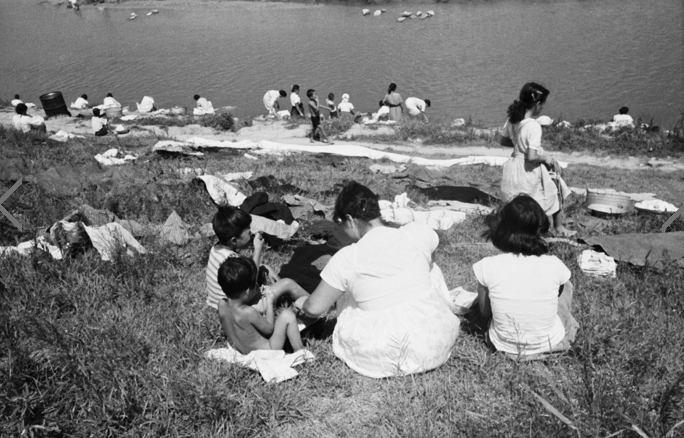
My mother—up until that point, she hadn’t even learned how to read the Korean alphabet, but she was a woman of fierce, unbreakable determination. Serving hot, freshly cooked rice three times a day and shopping at the market every single day to prepare fresh side dishes was entirely her responsibility. Oh, and the “print machine”—that exhausting, arm-breaking task of pushing the mimeograph roller up and down over the ink plate was also a burden my mother carried entirely on her own. With every move we made, our family grew. First, two younger siblings were born below me. On top of that, my grandfather—a lifelong free spirit who loved singing and dancing, and who always believed that wine must naturally accompany them—finally brought his wanderings to an end and came to live with us.
From around the second grade of elementary school, right when my father’s shop sign changed from a stamp shop to a printing shop, making runs “inside the city gates” (downtown Seoul) became my job. I would go to the Sisa Publishing Company located next to the Myeongdong Cathedral, or to the Cheongjosa Publishing Company in the back alleys of the Danseongsa Theater, to buy metal type pieces. I would also head to the paper mills in Euljiro to carry back large sheets of paper neatly cut into 8-cut or 16-cut sizes. My meticulous father would explain the differences between the Myungjo and Gothic fonts until my ears grew numb, and he would carefully draw out each Chinese character by hand for me, adding a recurring refrain: “Make sure you double-check it.” It is entirely thanks to my father that I learned Chinese characters. Those errands inside the city gates were a source of great joy for me—at least, until I entered the threshold of adolescence.And then, we finally achieved my mother and father’s ultimate dream: we got a home of our very own. It happened right before I graduated from elementary school.
Recent Comments